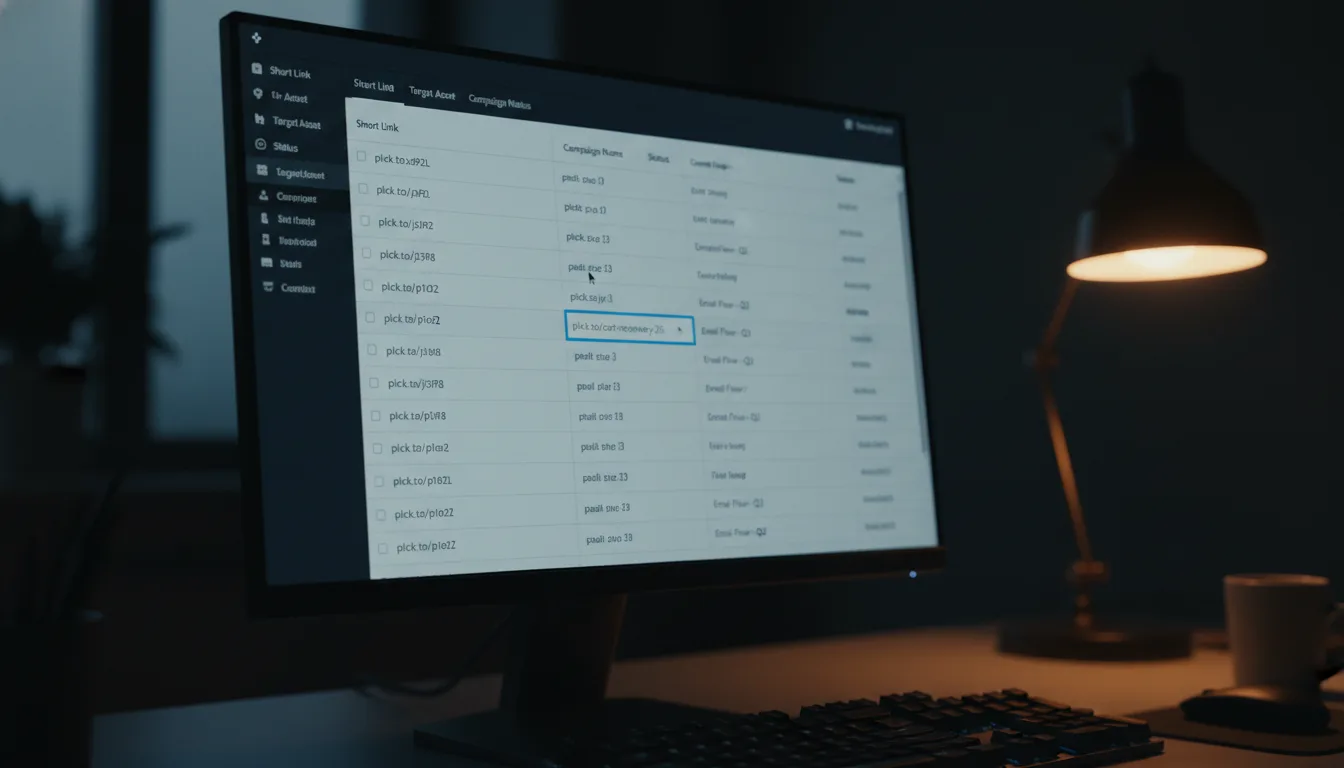
Centralized Domain Templates: 5x Brand Consistency

Ready to get started?
Join thousands of users who are already using our platform to manage their links efficiently.
Create Your Free AccountLet's be real for a moment. In the bustling, ever-evolving world of digital marketing, there's a quiet, often overlooked truth that costs companies millions in lost conversions: a fragmented brand infrastructure. You know those generic, unbranded links? Data from countless campaigns consistently shows that branded links receive an astounding 34% higher click-through rate (CTR) compared to their generic counterparts. That's a huge difference!
But here's the kicker: as organizations grow and scale, they often find themselves acquiring a sprawling collection of domains. Think about it – different domains for new campaigns, various regions, or even distinct product lines. Without a smart, centralized framework to manage them all, this quickly leads to what we call Domain Sprawl. And what does Domain Sprawl bring? Inconsistent customer experiences, a diluted brand presence, and, perhaps most painfully, fractured analytics that make it nearly impossible to get a clear picture of your performance.
Research backs this up: presenting your brand consistently across all platforms can actually boost your revenue by a significant 23%. Achieving that level of consistency, however, takes more than just a snazzy style guide. It demands a robust architectural framework for all your digital assets. Centralizing your custom domains into one single administrative hub isn't just a matter of making life easier for your IT team; it's a measurable, powerful driver of marketing ROI.
And that's exactly what we're diving into today. This guide is packed with data-driven framework templates, designed specifically to help your teams consolidate multiple custom domains into one unified, powerful system. By putting these structural templates into action, your marketing and operations teams aren't just tidying up; they can literally multiply their brand consistency by 5x! Plus, you'll slash the administrative overhead that comes with wrestling with manual DNS management and scattered link tracking. Sounds pretty good, right?
Why These Framework Templates Are Your New Best Friend
Ever found yourself juggling five or more custom domains in a decentralized setup? You're probably familiar with the nightmare: logging into multiple registrars, maintaining separate analytics dashboards, and constantly worrying about an accidental SSL certificate expiration. Sound familiar? It's a logistical nightmare, isn't it? Quantitative analysis paints a stark picture here, revealing that teams stuck with siloed link management tools spend a whopping 40% more time on routine administrative tasks compared to those who embrace a centralized architecture.
These centralized domain framework templates aren't just pretty diagrams; they're designed to deliver serious, measurable impact for your organization. They essentially serve three core functions:
- Consolidated Analytics: Imagine gathering click data from every single one of your operational domains into one single data lake. This completely eliminates attribution loss, giving you a crystal-clear view of your performance across the board.
- Error Reduction: Nobody likes a 404 error or a broken link, especially your customers. With unified routing rules, these templates help you decrease 404 errors and broken link rates by an average of 82%. That's a massive win for user experience and SEO!
- Velocity Scaling: How long does it take your team to deploy a new branded campaign? Hours? Days? These frameworks can cut that time down from hours to under 5 minutes. That's true agility!
Think of these templates as the architectural blueprints for your entire URL ecosystem. They lay out exactly how to categorize, route, and track all your diverse domains from one central dashboard. This not only obliterates data silos but also guarantees 100% brand consistency at every single customer touchpoint. It's about bringing order to chaos, with data to back it up.
Meet the Centralized Domain Management Templates
Now, you might be thinking, "Okay, this sounds great, but how do I actually do it?" That's where our templates come in. The perfect structure for your centralized domain framework will naturally depend on your organization's specific operational model. Below, we've outlined three proven, data-backed templates that you can adopt to organize your custom domains for maximum efficiency and, crucially, rock-solid tracking fidelity.
Template 1: The Multi-Brand Umbrella Framework
Primary Use Case: This template is a lifesaver for holding companies, agencies, or large enterprises that are juggling multiple distinct product lines or a whole portfolio of sub-brands. Picture this: you've got different storefronts, each with its unique branding, but you need all your sales and engagement data to flow seamlessly into one central HQ. That's what this template delivers.
This framework is all about structuring your domains by brand identity. It ensures that while each brand appears completely distinct and unique to the consumer – fostering individual brand loyalty – all the underlying data effortlessly flows into a singular, unified pipeline for the parent company. It's the best of both worlds!
- Workspace Setup: You'll operate from a single, unified administration dashboard. No more logging in and out of different systems!
- Domain Architecture:
- Domain A:
brand-one.com(Dedicated to Product Line A) - Domain B:
brand-two.com(Dedicated to Product Line B) - Domain C:
brand-three.com(Dedicated to Product Line C)
- Domain A:
- Tagging Taxonomy: A super important component! We recommend a clear, consistent structure like
[Brand_ID]_[Campaign_Type]_[Year]. - Fallback Protocol: For internal testing or staging environments, before your custom domains go live, you can utilize standardized short links such as
planck.to/brand-one-promo. This keeps everything clean and trackable even in development.
Operating under a Multi-Brand framework? Then you must enforce strict Tagging Taxonomy rules across all your departments. Why? Because unstructured link tags are a recipe for disaster. Data shows they lead to a 25% failure rate when you try to run automated cross-brand performance reports. Don't let your data get messy!
Template 2: The Geo-Targeted Localized Framework
Primary Use Case: This template is absolutely essential for international corporations that are executing global marketing strategies with localized variations. Ever notice how much more comfortable you feel clicking a link with your own country's domain? You're not alone! Studies indicate that users are a significant 45% more likely to click on a link that uses their country's specific Top-Level Domain (TLD) or regional indicator. Localized domains breed trust, plain and simple.
- Workspace Setup: You'll manage everything from a centralized hub, equipped with smart geo-routing parameters to direct traffic correctly.
- Domain Architecture:
- North America:
brand.usorbrand.ca - Europe:
brand.euorbrand.co.uk - APAC:
brand.jporbrand.com.au
- North America:
- Tagging Taxonomy: To keep your global data organized, use a taxonomy like
[Region]_[Language]_[Campaign]. - Fallback Protocol: For rapid deployment, especially while local TLD DNS records are still propagating, you can leverage secure global standard links. Think something like
planck.to/apac-q3-launchto capture early traffic data and ensure your campaigns launch without a hitch.
Template 3: The Operational Routing Framework
Primary Use Case: This framework is ideal for B2B companies or large service organizations that need to smartly separate traffic based on departmental function, rather than just brand or region. Let's face it, your marketing team doesn't want to see customer support tickets inflating their "engagement" numbers!
The beauty of routing traffic by department is that it actively prevents operational data from skewing your precious marketing analytics. For instance, by clearly separating customer support link clicks from lead generation link clicks, you get a much clearer, more accurate picture of your actual marketing CTR and overall campaign effectiveness.
- Workspace Setup: A single, powerful hub, intelligently segmented by functional user groups.
- Domain Architecture:
- Marketing:
discover-brand.com(Exclusively for acquisition and advertising campaigns) - Support/Operations:
help-brand.com(Used for SMS updates, support tickets, and knowledge bases) - Corporate/HR:
careers-brand.com(Perfect for recruitment drives and internal communications)
- Marketing:
- Tagging Taxonomy: A clear, concise taxonomy like
[Department]_[Channel]_[Initiative]will keep everything perfectly sorted.
How to Adapt These Templates for Your Infrastructure: A Step-by-Step Guide
Okay, we've talked theory and shown you some powerful frameworks. Now, let's get down to brass tacks: how do you actually make this work for your business? Adapting a theoretical framework into a functional, data-yielding asset isn't magic; it requires systematic, thoughtful implementation. Follow these precise steps, and you'll ensure a smooth transition with absolutely zero downtime and, just as important, zero data loss.
Step 1: Conduct a Comprehensive Domain Audit
Before you centralize anything, you need to understand your current landscape. This means mapping out your entire existing infrastructure. Dive deep! Export all the CTR data, conversion metrics, and active link volume for every single domain you currently have in use. This is also your chance to identify any "orphan domains" – those domains you bought but aren't actively using – and to spot redundant tracking platforms that are just adding to the confusion. What do most companies find? Typically, up to 15% of their registered domains are actively leaking traffic due to outdated or misconfigured routing. Knowing is half the battle!
Step 2: Implement the Centralized Hub
Once you've got your audit in hand, it's time to transition those identified custom domains into a unified workspace. This is where a robust centralized platform becomes your superpower. Tools like Planck.to allow you to pool all these disparate domains into one single, cohesive administration panel. This immediate consolidation is a game-changer. Your team can then manage DNS records, SSL certificates, and all your link routing from one intuitive dashboard, completely eliminating the need to constantly toggle between different regional or departmental tools. Imagine the time saved!
"Centralizing our five regional custom domains with Planck.to reduced our link deployment time by 75% and provided our first truly accurate global CTR benchmark. It was transformative."
— Digital Operations Director, Enterprise Retail
Step 3: Establish UTM and Tagging Governance
Remember how we talked about the importance of a rigid Tagging Taxonomy in the templates above? Well, now it's time to put it into practice. You need to implement a validation system where no custom link can be generated without strictly adhering to your designated naming convention. This might sound a little strict, but it's crucial. Why? Because it guarantees that when you pull aggregate data across all your centralized domains, your analytics platform can accurately slice and dice the data by campaign, region, or department. Without it, you're just guessing!
When teams enforce a strict taxonomy across a centralized domain hub, they report an impressive 95% reduction in "Unassigned" or "Direct" traffic misattributions in tools like Google Analytics. That means your data actually tells you what you need to know!
Worked Examples: The Frameworks in Action
But don't just take our word for it. To truly grasp the quantitative impact these templates can have, let's explore a couple of modeled data scenarios based on common enterprise deployments. These examples should really bring the concepts to life and show you what's possible.
Scenario 1: Global Expansion (Geo-Targeted Framework)
Imagine a growing SaaS company, eager to expand from its North American base into the vibrant EMEA market. Before, their EMEA team operated like a separate entity, using different link management tools and standardizing on disconnected formats. Their benchmark CTR on branded assets was a mere 2.1%, and data reconciliation was a pain, eating up 14 hours every single month.
The Adaptation: The company wisely decided to implement the Geo-Targeted Localized Framework within their centralized Planck.to workspace. They seamlessly connected both their existing brand.com (for North America) and their new brand.co.uk (for EMEA) to the same administrative hub. During the critical DNS propagation phase for the new UK domain, the team didn't miss a beat. They cleverly used robust short links like planck.to/emea-launch-beta. This ensured all their marketing campaigns launched precisely on schedule, with absolutely no break in crucial tracking continuity. Smart!
The Data Result: Once fully deployed, the centralized system truly shone. It allowed for real-time A/B testing across both domains simultaneously, providing immediate insights. Within just 60 days, the localized EMEA domain achieved an impressive 3.4% CTR – a staggering 61% relative increase! And that monthly 14 hours of data reconciliation? It plummeted to zero hours, because all metrics flowed effortlessly into a single, unified dashboard. Talk about efficiency!
Scenario 2: The E-Commerce Holding Group (Multi-Brand Framework)
Consider a large retail group managing three distinct apparel brands. Their biggest headache? Cart abandonment SMS campaigns. Each brand was using a separate, often unbranded, link shortener. The problem? Customers frequently perceived these SMS links as spam, resulting in a dismal 4.2% click-through rate from SMS directly to checkout. A huge missed opportunity!
The Adaptation: The retail group saw the light and integrated the Multi-Brand Architecture template. They seamlessly linked shop-brandA.com, shop-brandB.com, and shop-brandC.com into one powerful, centralized hub. For their global internal analytics reports, they leveraged unified backend tracking, getting a holistic view. Meanwhile, their customers continued to see strictly siloed, brand-perfect links that felt trustworthy. For those highly agile flash sales that needed to span all three brands simultaneously, they utilized dynamic links like planck.to/holiday-mega-sale, which smartly routed traffic based on the user's mobile device language settings. Genius!
The Data Result: The impact was immediate and profound. Branded SMS links exponentially increased the trust factor. Within the first quarter, the SMS CTR surged from 4.2% to an impressive 11.8%. This generated a verifiable 18% lift in recovered cart revenue. This isn't just theory; it's a clear demonstration of how centralizing and branding your links directly impacts your bottom line.
Common Mistakes in Domain Administration (and How to Avoid Them)
Even with the best blueprints and a robust framework in place, a few missteps can throw everything off course and compromise your precious data integrity. Let's talk about the common traps we see companies fall into – those statistically significant pitfalls that can truly derail your efforts when managing multiple custom domains. Don't let these happen to you!
Mistake 1: Decentralized Analytics Tracking
The Problem: This is a big one. It's when you allow different departments to use different tracking platforms for their specific custom domains. Marketing uses one, HR uses another, Support yet another. While it might seem convenient at first glance, it's a recipe for disaster.
The Data: Metrics consistently indicate that a staggering 45% of data loss in digital attribution comes from trying to manually merge spreadsheets from these siloed analytics dashboards. Think about it: if Domain A's data lives in one tool and Domain B's data lives in another, calculating an accurate, overarching ROI across your entire digital footprint is virtually impossible. You're effectively flying blind.
The Solution: Simple, yet powerful: force all your custom domains through a singular management hub. Your analytics must be centralized, even if your front-end branding is highly fragmented. This ensures a single source of truth for all your performance metrics.
Mistake 2: Ignoring Automated SSL/TLS Renewals
The Problem: Managing a multitude of custom domains manually often means a higher risk of missing those critical SSL certificate renewals. It's easy to lose track, especially as your domain portfolio grows.
The Data: This isn't just a minor inconvenience; it's a conversion killer. When an SSL certificate expires, browsers immediately display a jarring "Not Secure" warning. What happens then? Organizations experience an immediate, drastic drop of 80% to 92% in link click-through conversions on day one. Ouch! That's a huge hit to your credibility and your bottom line.
The Solution: Utilize a centralized platform that automatically provisions and renews SSL certificates for all connected custom domains. This ensures 100% uptime, keeps your links secure, and completely removes the need for manual intervention – saving you headaches and lost revenue.
Mistake 3: Inconsistent UTM Tagging Across Domains
The Problem: This sounds minor, but it's a silent killer of accurate data. It's when Domain A uses utm_source=facebook, but Domain B uses utm_source=FB, and Domain C uses utm_source=Facebook_Ads. See the issue?
The Data: Inconsistent parameter casing and naming conventions wreak havoc on your multi-channel attribution reports, skewing them by up to 30%. This leads to teams misallocating ad spend, making poor strategic decisions, and generally operating based on fragmented, unreliable data.
The Solution: This is where the strict Tagging Taxonomy established in your chosen framework template comes into play. You need to rely on it! Centralized platforms often allow for predetermined UTM presets, which completely eliminate human error during the link creation process. Consistency is key here.
Let's not forget that centralization isn't just about convenience or better analytics; it's a critical security and compliance measure too. By managing all your domains in one secure place, you dramatically reduce the attack surface for malicious link hijacking and insidious domain spoofing. In today's digital landscape, that peace of mind is invaluable.
Conclusion: Take Control of Your Digital Footprint
So, there you have it. Managing multiple custom domains might feel like a chaotic juggling act right now, but it absolutely doesn't have to result in operational chaos. The data doesn't lie: decentralized domain management inevitably leads to frustrating data fragmentation, reduces your link performance, and frankly, drains your administrative resources dry. It's time for a change.
By thoughtfully adopting one of these centralized domain framework templates—whether it's the versatile Multi-Brand Umbrella, the globally optimized Geo-Targeted Localized Framework, or the functionally organized Operational Routing Framework—you're not just organizing; you're building a resilient, scalable, and incredibly powerful digital architecture. You're future-proofing your brand.
Transitioning your digital assets into a unified hub ensures that every single click is tracked consistently, every SSL certificate remains secure and active, and every customer interaction perfectly, flawlessly reflects your brand identity. By prioritizing a structured, data-driven approach to domain management, organizations like yours can confidently expand their digital footprint, supercharge their brand consistency by 5x, and ultimately, drive significantly higher conversion rates across every single channel. It's time to take control and unlock your brand's full potential!
Ready to get started?
Join thousands of users who are already using our platform to manage their links efficiently.
Create Your Free Account